




Baga Gazriin Chuluu
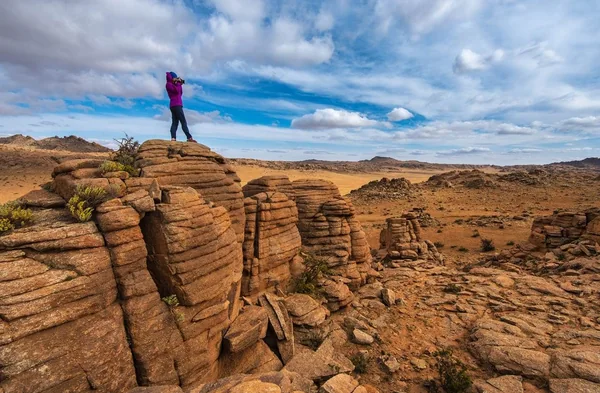
Baga Gazriin Chuluu is a granite mountain area rising from open plains about 37 km northwest of the center of Delgertsogt sum in Dundgovi Province. It covers roughly 300 square kilometers, and its highest summit, Takhilgiin Khavtsal, reaches 1,768 m above sea level.
Many springs flow through its valleys and hollows, and the area is dotted with ancient tombs, khirigsuur stone mounds, rock paintings and carved stone monuments. The main sights are Sodotiin Am, Jargalant Cave, Nudnii Rashaan (the "Eye Spring"), Takhilgiin Khavtsal, Ger Khad (Ger Rock) and the Xiongnu-era tombs.
Ger Khad is engraved with several images, including a figure leading two ibex on a rope, a row of twelve ibex, vertical lines and signs, dated to the late Bronze Age. On a reddish cliff nearby, two large deer are depicted life-size, about 170 cm long and 90 cm high.
Sodotiin Am takes its name from the sod grass that once grew thickly in the valley. In the poplar grove in the middle of the valley, two monks are said to have lived in meditation about 300 years ago. The ruins of Lovonchamb Monastery lie here, and in the early 20th century the scholar-monk Zava Damdin stayed here and wrote his works.
Jargalant Cave, about 1 km from the valley entrance, is an 18 m long cave that you walk through partly upright and partly crawling in a seated position. Nudnii Rashaan, the "Eye Spring", lies about 1 km west of the entrance. Looking down a narrow hole you can see water 50-60 cm below; locals say it is good for the eyes and traditionally lower a tiny spoon on a string to scoop the water and dab it on the eyes.
In Dund Shand valley, 64 Xiongnu-era tombs are gathered in one place, lined up from west to east. A joint Mongolian-Hungarian-Soviet team excavated them in 1989 and found bone bow plates, bronze belt ornaments, an iron horse bit and fragments of pottery with wave patterns.
Photo gallery
Gobi highlights
Tell us your dates and group size.
Contact