




Tsagaan Suvraga (White Stupa)
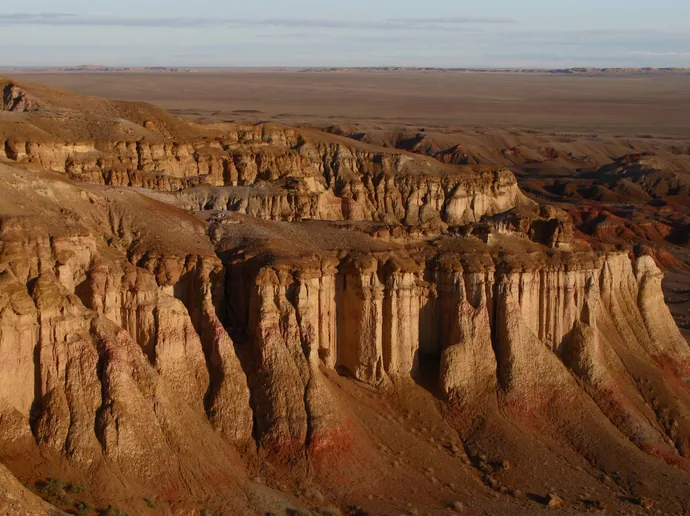
Tsagaan Suvraga ("White Stupa") is a scenic landmark in Ölziit sum, Dundgovi Province, about 450 km from Ulaanbaatar. Roughly 420 km of the journey is on paved road, and the final 30 km follow local dirt tracks.
The cliffs are what remains of a vast ancient lake. As the water slowly receded over the centuries, clay layers from the lakebed were exposed, and rain and flash floods have carved them into striking walls, ridges and gullies.
The highest point stands about 1,327 m above sea level. The surface is deeply cut by dry channels and ravines and has hardened almost like rock. The formation is about 400 m wide, its base is said to stretch for around 1 km, and the central wall is an almost vertical face some 60 m high.
Seen from a distance on the east side, it looks like the ruins of a walled city, with rows of buildings and towers; from the west it is almost invisible.
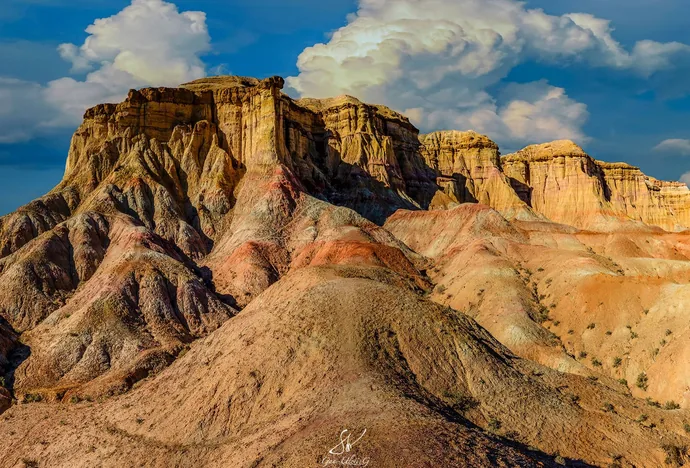
At sunrise and sunset the layers glow in many colors, and visitors are often left speechless. Local people have long revered the site as "Tsagaan Khairkhan" (the White Sacred Mountain).
Until about ten years ago it was visited by only a few people, but in recent years it has drawn attention from both domestic and international travelers and has become a highlight of the Gobi route.
Nearby highlight: Del Uul (Del Mountain)
Del Uul is a mountain in Ölziit sum, Dundgovi Province, extending about 17 km east to west and 8 km north to south, lined with small rocks that run like a horse's mane. The entire mountain is like one big rock-art gallery.
Researchers have studied it since 1986. Besides petroglyphs, it holds runic, Chinese, Uyghur and Tibetan inscriptions, tombs of various shapes, khirigsuur stone mounds, deer stones, temple ruins and Stone Age remains. Rare animals such as argali, ibex and black-tailed gazelle live here, and medicinal plants grow here too.
There are about 3,000 petroglyphs, which researchers believe were made over several thousand years in five periods, from the Neolithic, Bronze and Iron Ages through the Xiongnu and Turkic eras. People kept drawing here, it is thought, because the natural conditions were good, game was plentiful and the place was used for religious rituals. The images show daily life, clan conflicts, battles, hunting, livestock and travel, including 20-30 people dancing in a circle, gers with windows, and four-wheeled camel and ox carts.
At a spot called "Zuun Biluut" there are especially many images of ibex, horses, riders and camels. Ibex with long curved horns and riders holding weapons on horseback show how important the horse has always been to the Mongolian people.
At a place called Elst Khotol, the upper part of a slab from a square stone-enclosed tomb bears a scene of many people dancing. It is known as "Thirty-two People", and Dr. S. Dulam based a dance drama, "Khumurgun Gurvaljin", on it. The work was performed at a Paris theater at UNESCO's invitation, telling an ancient story through animal and human voices, primal movements and gestures, and reaching audiences of every language and culture.
A runic inscription on the rocks reads: "We are not a state that has received a title, so we came to hunt in this place." Researchers think it may have been written by powerful Turkic nobles in protest against receiving Chinese titles from the Tang dynasty. Because Del Uul's thousands of rock paintings are somewhat distinctive, the site was placed on UNESCO's tentative list for World Cultural Heritage in 2007.
Photo gallery
Gobi highlights
Tell us your dates and group size.
Contact