Mongolia tours with free WiFi during your trip – leave it to a local specialist travel company.

Contact us for advice and quotes on local Mongolia toursEmail:info@nomadmongolia.com

Mongolian Naadam Festival and Naadam Events



One of the festivals Mongolians have celebrated since ancient times is the Naadam Festival. Since 1921 it has been held every year on July 11, Revolution Day. Its central events are, of course, the "Eriin Gurvan Naadam" (the three manly games) of horse racing, archery and wrestling. It is held every year on July 11 and 12. Naadam is a men's festival, with national championships in horse racing, wrestling and archery. Men of all generations compete in their skills for the pride and honor of being nomads.
The horse racing runs over 2 days, with 3 races a day. They are divided into classes of two-year-olds, three-year-olds, four-year-olds, six-year-olds and over, and stallions only, competing for speed. The sight of nearly 1,000 horses thundering along a course of 60 km round trip is truly overwhelming.
Mongolian Wrestling

It is thrilling to wonder who will win at this year's Naadam festival! All Mongolians love Mongolian wrestling, and both men and women like it, though many more men love it. 512 wrestlers from Mongolia's 21 provinces take part and fight in a tournament format.
The 8th round (Naimdugaar Davaa) is the semifinal and the 9th round (Yusdugaar Davaa) is the final. Wrestlers who win at Naadam are given a title. Winning at Naadam once earns the title "Arslan" (lion), winning twice "Avarga," and a fifth win "Darkhan Avarga," and once a title is gained it is never lost. Many who reach the higher titles become entertainers or politicians. The wrestlers' costume is also worth noting. They fight wearing a long-sleeved, open-chested jacket called a "zodog," short trunks called "shuudag," Mongolian boots with upturned toes (Mongol gutal), and a hat with a tower-like point in the center (janjin malgai).
Mongolian Horse Racing
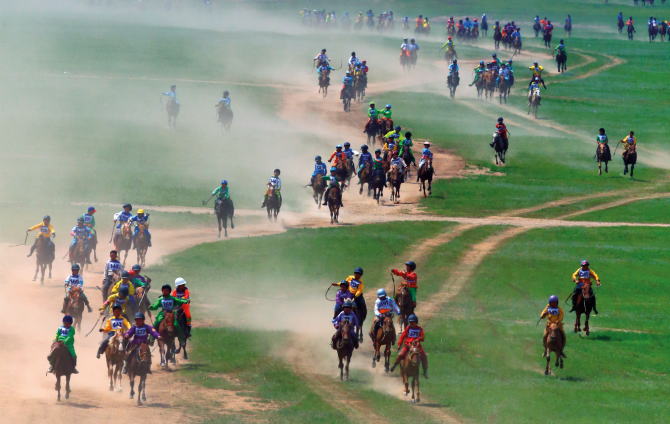
Alongside Mongolian wrestling, the other important pleasure of the Naadam Festival is horse racing.
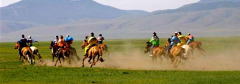
The horse races include "Azarga (stallion)", "Ikh Nas (horses six years and older)", "Soyolon (five-year-olds)", "Khyazaalan (four-year-olds)", "Shudlen (three-year-olds)", "Daaga (two-year-olds)" and "Jorool Mori (pacing horses)". Mongolian horses are short with short legs and are said to excel at running long distances. Several hundred horses race over long distances, from 15 km for two-year-olds to over 30 km for Ikh Nas. In each race the top five horses are called "Airag", and verses praising the horse are chanted and airag is sprinkled on it in blessing. It is also said to be lucky to be covered in the dust of the race or to get the sweat of the winning horse on your body. In Mongolian horse racing the jockeys are boys and girls aged 6 to 12. This is also a showcase of Mongolians, who are said to be "raised on horseback", but it is also to lighten the horse's load and let it run faster. Before the race starts, the jockeys sing an encouraging melody called the Giingoo. It is also a signal to the horses, and a pleasant tension spreads across the grand steppe. The most popular race is the two-year-olds' race. The first five become the five "Airag", but the people cherish even more the two-year-old that finishes last. The last two-year-old to arrive is given a prize meaning, "You are the slowest horse this year, so be the fastest next year."
Mongolian Archery Contest

The other competition of Naadam is archery. The shooting distance is 75 m for men and 65 m for women, and for those 17 and under it is calculated as age × 4 m for boys and age × 3 m for girls. The bows are 120 cm to 170 cm long, made with a bamboo core, with deer horn glued on to increase strength and both ends finished with birch. Arrows are about 1 m long, made of birch or willow-family deciduous trees, with eagle and other feathers at the back. Arrowheads use deer bone, and the targets are made by stacking surs, made from tanned cow or horse hide. They are round, about 8 cm high. A stack piled like a wall is called khana sur, and 30 surs arranged in two layers of 24 with 3 more on either side is called khasaa sur. There are individual and team events. In the individual event, adult men shoot 20 arrows at khana sur and 20 at khasaa sur, 40 arrows in all, women shoot 20 at khana sur and 16 at khasaa sur, 36 arrows in all, and those 17 and under, both boys and girls, shoot 20 arrows at khana sur and compete on hits. There are lines behind and 3 m in front of the target, and when a shooter's arrow hits the target, they call out "Uukhai!" to announce it. Spectators also enjoy calling "Hit!" and "So close!"
Mongolian Naadam Festival Tour: List of Optional Tours
NM-1001: Naadam Festival, Mongolian Wrestling, Horse Racing and Archery, July 11 Day Tour
|
Watch the Summer Festival, Mongolian Naadam, Departing July 11 Round-trip transfer, lunch included, English guide accompanies |
|||
 |
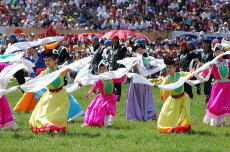
July 11: In the morning at 08:30, leave your hotel in Ulaanbaatar by private car. At 10:00 watch the opening ceremony of Naadam, Mongolian wrestling and the archery competition. |
||
|
Meals |
Breakfast: none |
Lunch: ○ |
Dinner: none |
|
Course code: NM-1001 |
1 person $505 |
2 people $470 |
3 people $405 |
|
* Khuushuur and khorkhog are traditional Mongolian dishes. Khorkhog is a Mongolian dish of chunks of mutton packed into a large can with vegetables, salt and spices, alternating with heated stones, and stone-cooked. * The Naadam Festival is held until7/11~7/13.7/11The opening ceremony is held and it is the most splendid day. |
|||
NM-1002: Mongolia Local Tour, Visit a Nomad's Ger, Herd Livestock!
| Watch Naadam and Nomad Homestay, 2-Day Tour, With Private Car, English Guide Accompanies | ||||
|
|
Day 1 |
In the morning at 08:30, leave your hotel in Ulaanbaatar by private car. At 10:00 watch the opening ceremony of Naadam, Mongolian wrestling and the archery competition. |
||
|
Day 2 |
After breakfast, by private car to the racecourse outside Ulaanbaatar. Watch the horse racing. Please enjoy Naadam khuushuur and airag. |
|||
|
Meals |
Breakfast: ○ |
Lunch: yes. Dinner: yes |
Dinner: ○ |
|
|
Course code: NM-1002 |
1 person $740 |
2 people $570 |
3 people $505 |
|
|
* Khuushuur and khorkhog are traditional Mongolian dishes. Khorkhog is a Mongolian dish of chunks of mutton packed into a large can with vegetables, salt and spices, alternating with heated stones, and stone-cooked. * The Naadam Festival is held until7/11~7/13.7/11The opening ceremony is held and it is the most splendid day. |
||||

 - Copy11.jpg)
Complete Guide to Naadam (Rules of Wrestling, Horse Racing and Archery)
| Meaning | A Mongolian word meaning "play". It was once called the "three manly games", with men enjoying wrestling, horse racing and archery. Now, apart from wrestling, they are sports women also take part in. |
|---|---|
| World Heritage | Inscribed on the UNESCO Intangible Cultural Heritage list in 2010 |
| Period | The summer Naadam is held across Mongolia from the second half of June through August. The State Grand Naadam is held in Ulaanbaatar on July 11–12 (the same dates every year; in 2027 too it is July 11–12). |
| Tickets | Stadium admission tickets and grandstand tickets near the horse-race finish are reserved to some extent by travel companies, and are very hard to obtain individually. They are sometimes sold at more than 10 times face value. Provincial Naadams make it easier to secure a viewing place. |
Origins of Naadam
Originally, Naadam was held together with the Ovoo festival, a festival to pray for rain. An ovoo is a mound of piled stones at a pass or the like, or an altar assembled from wood. The Ovoo festival was a ritual asking Tengri (Heaven), who governs everything on earth, for the blessing of rain, wishing for grass to grow and "a good summer to come", and was conducted by shamans and Buddhist monks. When the festival was held, the spirits and gods of the land were thought to gather, and wrestling, horse racing and archery were held there to show "how mighty the wrestlers", "how swift the fine horses" and "how wise the sages" were. "Being strong", "being fast" and "being wise" are the aspirations of the people of the steppe. Therefore, it is said to have been a sacred rite in which winning and losing came second.
In the socialist era, religion was suppressed, with many shamans and monks killed, and the Ovoo festival was banned. The religious elements were removed from the original festival, and what remained as sport is today's Naadam. After freedom of belief was gained, the number of regions where Naadam is again held together with the Ovoo festival increased. Since a situation arose in which, because rain did not fall, the Ovoo festival could not be held (in some regions it is held after the first rain of the year) and so Naadam could not be held either, the administration instructs that it be held by mid-August so as not to affect autumn nomadic work.
When the three games are held after events or milestones, such as a New Year Naadam or a Naadam after an event at a Buddhist monastery, it is called Naadam. A competition that does not hold all three games and centers mainly on horse racing is also sometimes called Naadam. Archery may not be held in some regions because of few participants or the uneven distribution of the participants' places of residence. Provincial-level Naadams tend to end before the State Grand Naadam, but district-level Naadams are not bound by this and are generally held during July.
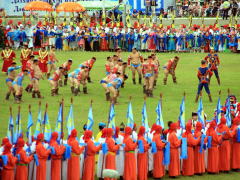
At the opening of the State Grand Naadam, the nine banners of Chinggis Khaan are carried from the Government Palace and enter the stadium.
How to Enjoy a Provincial Naadam
At provincial Naadams, whether at the stadium or near the horse-race finish, it is relatively easy to secure a viewing place. If you move about well, you can watch both wrestling and horse racing quite close. However, it is very hard to tell when anything will start, so spectators need patience and must also watch the movements of the Mongolians around them, or they will miss their chance.
Mongolian Wrestling (Bukh Barildaan)
A wrestler is called a bukh. The costume consists of the zodog (a long-sleeved vest open at the chest, tied with a string at the abdomen), shuudag (short trunks), gutal (leather boots with upturned toes, worn with felt socks inside) and a janjin malgai (meaning "general's hat": the center of the hat rises high like a tower, with the tip decorated with coral stones and the like; for high-ranking wrestlers medals are sewn on its four sides).
Mongolian wrestling is not of one kind; in general, "folk wrestling" (undesnii bukh) refers to Khalkh wrestling of the Khalkh, the largest group. There are also Buryat wrestling, Uzemchin wrestling in China's Inner Mongolia Autonomous Region, Oirat wrestling in the Xinjiang Uyghur Autonomous Region, and wrestling that survives in the Republic of Kalmykia, which differ not only in costume but also in rules and customs. Here we explain mainly Khalkh wrestling.
Rules
A bout is decided when a part of the opponent's body other than the palm touches the ground. Winning is expressed as "crossing the pass" and losing as "touching the ground". There are 45 basic techniques, and depending on the theory, combined techniques number as many as 666. By the rules there is no ground fighting, only standing techniques, but a Mongolian wrestler who once took part in an international judo tournament reportedly won a bronze medal using standing techniques alone. Their strength of leg and waist and their balance are superb, and they do not fall easily.
In the past the match time was unlimited and could last tens of minutes or hours. With the 2010 rule revision, if a bout is not decided after a time limit (10 to 25 minutes, varying by match) from the start of the bout, the wrestlers are made to take a grip.
Titles
Wrestlers are given titles called tsol according to their record. In the 11th century the names of birds such as khartsaga (hawk), burged (golden eagle), shonkhor (falcon) and garuda were used, but from the middle of the 13th century the titles nachin (falcon), arslan (lion) and avarga (giant, protector) came into use. Since 2005, at the State Naadam a wrestler who wins 5 rounds receives the title "State Falcon", 6 rounds "State Hawk", 7 rounds "State Elephant", 8 rounds "State Garuda", and 9 or more rounds "State Lion". A wrestler who wins for the first time gets the title Arslan, and when an Arslan wrestler wins the tournament he gets the title "State Avarga". A wrestler with the Avarga title, as he wins more championships, receives the titles Dalai Avarga, Dayan Avarga and Darkhan Avarga. Since World War II nine Darkhan Avargas have been born, but the most successful is Bat-Erdene Avarga, who has won the State Grand Naadam 11 times.
Progress of the Match
The competition is a tournament. Usually 512 wrestlers fight 9 rounds, though sometimes it is a 10-round tournament of 1,024. From the 3rd round on, wrestlers of high title choose their opponents. The wrestlers enter the arena from the south of the stadium. Each dances with arms spread as if a bird flapping its wings around his zasuul, a second (who stands beside the wrestler during the bout, gives advice, and sometimes also acts as referee). The zasuul sings his wrestler's praises in a ringing voice, and then the wrestler hands over his hat and goes to battle. The arena is not particularly marked off and there is no out of bounds; the bout continues with the wrestlers moving about anywhere unless the zasuul makes them take a grip again.
When the result is decided, the loser unties the string of his zodog and passes under the raised right arm of the winner, but if a wrestler of higher title or an elder is the loser, the winner passes under the loser's arm. The winner then goes around the nine banners of Chinggis Khaan displayed in the stadium like a bird flapping its wings, reporting and dedicating the victory to Chinggis Khaan.
Horse Racing (Mori Uralduun)
Mongolians say "the horse is the best friend", and while they regard riding a splendid horse as bliss, they have the humility to know that it requires appropriate ability. They believe that only when a horse accepts you are you allowed on its back. In horse racing, drawing out the horse's wonderful abilities is considered the most important thing. The trainer gains fame as the one who brought the horse into top condition, the owner as the one who has preserved the bloodline, and the jockey as the one who skillfully handled the splendid horse, but they are only supporting players to the horse's splendor. At the award ceremony for the first five horses in each race (called the five "Airag"), verses are sung aloud, hoping they reach Tengri, praising how splendid a fine horse it is and how gracefully it galloped across this land. The horse is the star.
In recent years, however, from the idea that the horse is an animal that raises good fortune, wealthy people who treat owning a good horse as a status symbol have become owners, and a situation not in keeping with the original spirit of horse racing is emerging.
Training and Preparation
Training begins about one month before the race. A small ritual may be performed before training. Once the horses for the race are chosen, a khadag (silk scarf) is tied to the mane and the horse is tethered to the oyaa (hitching line stretched on the north side of the house). The owner or trainer burns incense and purifies the horse, walking clockwise around it. Then, after the jockey mounts, airag (fermented mare's milk) is poured on the horse's mane and rump to purify it, and then the jockey drinks, and the participants enjoy a feast praying for victory.
The basics of training are to reduce and trim the horse's weight without letting its strength drop. The trainer or owner gives the jockey detailed instructions on where, how far and how fast to run, taking into account the daily weather conditions and so on. In the case of provincial Naadams, practice races (songa) are held, and the horse's condition is checked, final adjustments are made, and then it faces the real race. At the State Grand Naadam, some people come from hundreds of kilometers away, and some go around competing in the provincial races.
Race Schedule and Distances by Age at the State Grand Naadam
Races at the State Grand Naadam are held over the two days of July 11 and 12. In addition, at the Oyaachdiin Naadam (Naadam of the trainers), races for pacing horses (jorool mori) and thoroughbred crossbreeds are held. Races are run by horse age.
| Daaga (2-year-olds) | 10–12 km |
|---|---|
| Shudlen (3-year-olds) | 12–14 km |
| Khyazaalan (4-year-olds) | 15–17 km |
| Soyolon (5-year-olds) | 18–20 km |
| Ikh Nas (adult horses 6 and older) | 24–26 km |
| Azarga (uncastrated stallions) | 22–24 km |
The Race
The jockeys are small, light children, to keep the load on the horse to a minimum. There is a song called the Giingoo, which I hear the jockeys sing before the start to raise the horses' spirits. Once a poor young man named Giin came to enter the horse race, but because of his poor clothes he was not allowed to take part, and began to sing out loud how wonderful his horse (a daaga called Goo) was. The people who heard it were moved by the wonderful song and voice and let him take part, and he won with astonishing speed; the song is sung in the hope of the same luck.
At the start line a collapsible fence is placed, and when all the horses have entered inside the fence, the fence falls and the race starts. Because the horses are not lined up in a row to start, getting a good position at the start is also a chance for the jockey to show his skill. Because the distance is long and the race harsh, some horses die along the way. Since some children fall from their horses, wearing a helmet and protective gear is mandatory.
Mongolians say good fortune rises if you are covered in the dust of the Soyolon race in particular, and they gladly go to the venue. Also, in the Daaga race, attention gathers on the horse that finishes last. This horse is called "Bayan Khodood" (rich belly). It has a very big belly and likes grazing along the way more than racing; though regarded as "untrained" and "half-grown", people hold hopes that it will surely grow and become a great horse.
After seeing off the horses and jockeys heading to the start line, the spectators wait until they return, watching paraglider descents and trick riding displayed in front of the stands. Before long, when dust rises in the distance and it is known that the horses are galloping back, the crowd becomes excited. The horses gradually appear from the dust, and as they grow larger the heat of the stands heads for its peak. The spectators cheer loudly, and in the midst of it the children, desperately cracking their whips, make a last spurt toward the finish. Accompanied by the judges who identify the first five horses, they race across the finish line.
Archery
Compared with wrestling and horse racing it seems to be treated a little plainly, but at the State Grand Naadam it is held over the longest period (July 10–12). Uriankhai archery, Buryat archery, children's archery, Khalkh archery and others are contested, each with different rules. Women are said to have taken part since the 1950s.
Khalkh archery is said to have been established in the latter half of the Qing dynasty. The bows of the 1940s had longer wooden pieces at both ends than modern ones and were larger overall, but between 1950 and 1960 the earlier bow-making techniques were lost. Afterward, bows made following a request from China for 500 bows and arrows became the prototype of today's bows, but their range is said to be shorter than the old ones.
The target is made by stacking sur (cylindrical woven leather straps). There are two kinds of sur: a target stacked in a wall shape is called khana sur, and a target with 12 sur stacked in two tiers in the center and 3 placed on each side is called khasaa sur.
Arrows are shot from a distance of the bow length × 45, or 75 m for men and 60 m for women. There are individual and team events; in the team event, groups of 8 to 12 take 4 shots each and compete. When an arrow hits the target, the judges on both sides of the target spread both arms and say "Uukhai" to signal it, and also use gestures to indicate "a little more to the left or right".
In Mongolian archery the archer draws with the thumb hooked on the string and the index finger locking the thumbnail, then releases the index finger lock to shoot. The hand that draws the string never touches the arrow. Archery competitors are called sulchi, kharvaach and so on, and the winner is given the title "mergen (wise marksman)". Erkhii mergen means "thumb marksman", expressing how important the thumb is in drawing the bow.
In Ulaanbaatar it is held at the archery field outside the stadium, and demonstrations such as shooting while galloping on horseback are also performed. Entering and leaving the benches beside the field is free, but since most archers hold the bow with the left arm extended, unless you go to the benches on the archer's right side it is hard to observe the nocking of the arrow and the equipment. At the State Grand Naadam many women archers take part.

Naadam Festival, Hustai National Park and Terelj National Park, 7 days
The Naadam festival, where you try Mongolian wrestling, Mongolian horse racing and Mongolian archery. You will have khuushuur, which is indispensable at Naadam. Ger stay in Terelj National Park and a starry-sky observation tour.
Naadam Festival, Karakorum Ruins and Tsenkher Hot Springs, 8-Day Tour
3 nights in a city hotel and 4 nights in a ger, watching a Naadam festival event on the steppe. You can also see Erdene Zuu Monastery surrounded by white walls, Turtle Rock, the Karakorum Museum, Tsenkher hot springs, and ride horses on the steppe.2511.jpg)
Naadam Festival, Gobi Desert, Bayanzag and Central Gobi Sightseeing, 8 Days
3 nights in a city hotel, 4 nights in a ger. After watching Mongolia's biggest event, the Naadam festival, an 8-day tour by domestic flight to the Gobi Desert, Khongor Sand Dunes, Yolyn Am valley, Bayanzag and the wonderful scenery of the Central Gobi
Naadam Festival, Lake Khuvsgul and Meeting Reindeer, 8 Days
After seeing Naadam, Mongolia's biggest event, fly domestically to Lake Khuvsgul and meet the Tsaatan and their reindeer. Lake Khuvsgul, the "Switzerland of Mongolia", is Mongolia's largest freshwater lake, near the Russian border.



Basic Mongolia Information
Basic information

Tourist Destinations in Mongolia
Destination
Travel Guide
Travel guide
Winter Tours
Winter tours
Tailor-Made Travel
Tailor-made
Tourist Events
Tour events
Tourist Camps
Tourist camps
Ulaanbaatar Sightseeing
UlaanbaatarCity Tour

Mongolian Food
Mongolian Foods
Restaurant Guide
Restaurants
Gallery
Gallery
Car Rental
Car Rental
FAQ
FAQ