Mongolia tours with free WiFi during your trip – leave it to a local specialist travel company.

Contact us for advice and quotes on local Mongolia toursEmail:info@nomadmongolia.com

Lake Baikal
Irkutsk lies at the southern end of Lake Baikal, at the confluence of the Angara and Irkut rivers, and is the capital of Irkutsk Oblast. The city is divided into four parts by the Angara, Irkut and Ushakovka rivers.
The name Irkutsk means "town on the Irkut." After a fortress was built by a Cossack expedition in 1652, it served as a relay point for Russian caravans heading to China and Mongolia, and functioned as a base for exploring the interior of Siberia and the Far East.

After receiving city status in 1686, it developed as a center for developing Siberia, rich in natural resources.
In the 18th century it became a place of exile for young officers called the Decembrists, and the culture and arts they brought from the then capital, Saint Petersburg, had a great influence on Irkutsk. Gorgeous stone buildings modeled on Saint Petersburg, cutting-edge technology and art took root in Irkutsk.
Educational facilities were also developed, and a Japanese language school, with shipwrecked Japanese as teachers, was founded in the mid-18th century. Present-day Irkutsk still preserves many streets and historic buildings of the time, and many wooden buildings decorated with traditional Russian carved window frames remain, leaving a beautiful cityscape.
Today Irkutsk is a transport hub connecting northern Siberia, where mineral resources are being developed, rapidly developing China and Mongolia, and the Russian Far East, whose ties with Japan are growing closer, with Moscow and on to Europe. Irkutsk now has a population of 670,000 and has grown into Siberia's largest industrial city, with some 70 major industries including machine building, sawmilling, furniture, food and construction.
The largest shares come from thermal and hydroelectric power, the automobile industry, metallurgy, aviation, timber and building materials. The world-famous fur industry also supplies sable and other furs to the world market. Irkutsk is a major academic city, with Irkutsk State University, the first founded in Eastern Siberia, the Second Science Center of the Siberian Branch of the Academy of Sciences, and the Limnological Institute on Lake Baikal, and students make up 10 percent of the population.
Citizens' cultural and artistic activities are also lively, with well-developed facilities such as theaters, cinemas and libraries.
Irkutsk preserves many 19th century wooden houses, churches and other buildings, was added to the World Monuments Fund list in 1997, and is also described as the "Paris of Siberia." Irkutsk has 685 surviving historic monuments, of which 108 are designated national monuments.
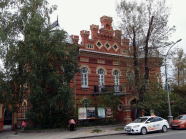
Of particular interest, the area around Kirov Park, next to Amurskaya Street, is the oldest district of Irkutsk, with historic buildings such as the Spasskaya Church, the Bogoyavlensky Cathedral, the statue of Alexander III and the Regional Museum (formerly the Siberian branch of the Russian Geographical Society).
There are also the Decembrists' House Museums (the "Volkonsky House Museum" and the "Trubetskoy House Museum"), the most culturally and historically important in Irkutsk.

Lake Baikal, called the "Pearl of Siberia" or the "Blue Eye of Siberia," boasts the greatest depth and the highest transparency in the world. It is 1,741 m deep, with a transparency of 41 m, and is an extremely large lake, 47 times the size of Lake Biwa. Lake Baikal is thought to have formed 25 million years ago, one of the few ancient lakes in the world. Lakes usually live for around 10,000 to 15,000 years and shrink with sediment, but Lake Baikal still continues to grow about 2 cm a year.
One of the unique features of Lake Baikal is the animals and plants that live there. Of the 2,635 species of animals and plants living in Lake Baikal, about 70% are endemic to this lake.
Especially famous is the Baikal seal, a freshwater seal found only in Lake Baikal. This seal was originally a marine animal, thought to have traveled up the Yenisei and Angara rivers and eventually adapted to fresh water. Lake Baikal, also called the "lake of miracles," was registered as a World Heritage Site in 1996. Endemic fish such as the golomyanka (the most numerous fish in Lake Baikal) and the omul are also well known, and the omul, resembling salmon and trout, is a familiar fish on local tables.
Lake Baikal is Russia's proud World Heritage Site, holding about 20% of the world's fresh water. The lake is so large that locals call it a "sea," and in winter it freezes over completely. The ice is more than 1 m thick and cars drive across the lake.

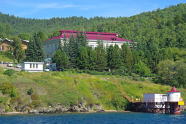 |
Lake Baikal Museum |
| Kirov Square A park named in memory of the revolutionary Kirov, who spent a year here from 1908. Surrounded by buildings such as the Irkutsk Oblast government, a church and a linguistics university, with a beautiful fountain in the center, it is a place of rest for citizens. It has long been the center of Irkutsk and is the oldest district in the city. Nearby are the Spasskaya Church and the Bogoyavlensky Cathedral. It was once called "Kremlin Square" because a kremlin (fortress) stood nearby. In winter it is decorated with Christmas trees and various ice sculptures. |
 |
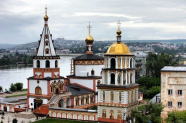 |
Bogoyavlensky Cathedral |
|
Irkutsk Regional Museum |
 |
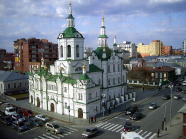 |
Spasskaya Church |
|
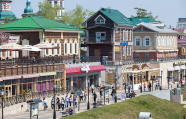
Irkutsk Sightseeing Spot: 130 Kvartal |
 |
Irkutsk and Lake Baikal Tour (Suspended)

8-Day Lake Baikal Tour from Mongolia to Russia by Trans-Siberian Railway
Fly direct to Ulaanbaatar. After seeing World Heritage Karakorum, take the Trans-Siberian Railway to Irkutsk and Lake Baikal. Return home from Irkutsk.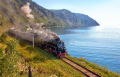
From Your Country to Russia's Lake Baikal, then by Trans-Siberian Railway to the Mongolian Steppe, 8 Days
Irkutsk and Lake Baikal sightseeing by direct flight, Circum-Baikal Railway sightseeing and Irkutsk city sightseeing, then by Trans-Siberian Railway to Mongolia. Enjoy a ger stay and horse riding experience at Undurshiret on the steppe.
Siberia: Irkutsk City and Lake Baikal Tour by Direct Flight, 5 Days
Even in summer the average is 12 to 24 degrees. Tour the Siberian land and World Natural Heritage Lake Baikal. Enjoy the unique streets of Irkutsk, a ride on the Circum-Baikal Railway, and great nature!



Basic Mongolia Information
Basic information

Tourist Destinations in Mongolia
Destination
Winter Tours
Winter tours
Tailor-Made Travel
Tailor-made
Tourist Events
Tour events
Tourist Camps
Tourist camps
Ulaanbaatar Sightseeing
UlaanbaatarCity Tour

Mongolian Food
Mongolian Foods
Restaurant Guide
Restaurants
Gallery
Gallery
Car Rental
Car Rental
FAQ
FAQ