Mongolia tours with free WiFi during your trip – leave it to a local specialist travel company.

Contact us for advice and quotes on local Mongolia toursEmail:info@nomadmongolia.com





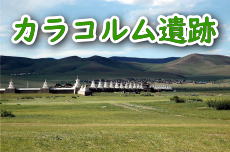
Mongolia has many highlights besides the steppe. In the cultural landscape area known as the Orkhon Valley, many ruins and historic sites remain, and the most famous is the Karakorum ruins. When the Mongol and Turkic nomads who have long lived in Mongolia founded their states, they chose the Orkhon River basin for their capitals. Chinggis Khaan also ordered the capital of the Mongol Empire to be established there. By his order, the city of Karakorum was built in 1235, and it is famous for having been, for a time, the center of the world. Erdene Zuu of the Karakorum ruins is one of Mongolia's World Heritage Sites. Suddenly appearing in the steppe, the ruins consist of 108 striking white stupas and outer walls surrounding the Buddhist temple, a group of monasteries with a long history in Mongolia. A little walk from the ruins is Turtle Rock, and the site where the "Karakorum History Museum" was built by a joint project of the Mongolian Cabinet and JICA with Japanese ODA.
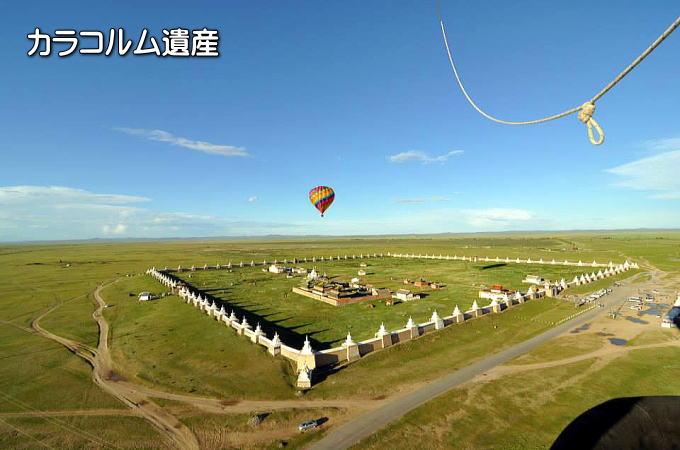

On the way from Ulaanbaatar to Karakorum you can see fields, grand steppe, sand dunes, various animals, birds and plants. Karakorum was once the capital of the Mongol Empire and is 365 km from Ulaanbaatar.
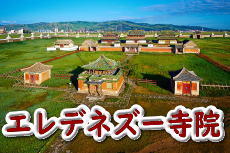
Erdene Zuu Monasterywas the first Buddhist monastery, built in 1586 by Abtai Khan using materials from the Karakorum of that time. An invitation from the flow of historical time through the old capital of the Mongol Empire awaits you. It has been protected as a special state-protected site since 1944. Erdene Zuu has walls 420 meters long on each of its four sides, with 25 stupas on each side and two at each corner, for a total of 108 stupas. It now serves as a museum. UNESCO designated Erdene Zuu and the ruins of the city of Karakorum a World Cultural Heritage site in 1996. While viewing Karakorum, you can also visit the Ulaan Tsutgalan waterfall, the 45–70°C hot springs of Mogoit, Elsen Tasarkhai, Ovgon Khiid and more.

The Cultural Landscape of the Orkhon Valley, about 360 km northwest of Ulaanbaatar - World Heritage
The cultural landscape of the Orkhon Valley, spreading along both banks of the Orkhon River in central Mongolia, was inscribed as a UNESCO World Heritage Site (cultural heritage) in 2004 as conveying the nomadic traditions of more than 2,000 years of history.
The main monuments of the cultural landscape of the Orkhon Valley are:
● The Orkhon inscriptions
● The Khar Balgas ruins with the remains of the 8th-century Uighur Ordu Baliq
● The ruins of Karakorum, the old capital of the Mongol Empire
● Erdene Zuu Monastery, the first Buddhist monastery in Mongolia
● The palace ruins on Doit Hill, thought to be the residence of Ogedei. These are precious heritage of the nomads spreading across the Orkhon River basin. On the Orkhon River, the Orkhon Waterfall, popularly called the "Red Falls", gives the steppe the blessing of abundant water.
The Karakorum city ruins and a turtle stone from the Mongol era outside the wall of Erdene Zuu Monastery
At the end of the 16th century Karakorum fell into ruin as materials were procured for building the Tibetan Buddhist monastery of Erdene Zuu. After that it disappeared from history for a while, but at the end of the 19th century a Russian researcher discovered the ruins and research progressed. At the end of the 20th century a joint Japanese-Mongolian survey was carried out. The "Karakorum Historical Museum" was built, by a joint project of the Mongolian Cabinet and JICA and with Japan's ODA, a short walk from the ruins near the turtle stone.


Karakorum Museum
The Karakorum Museum was built at the Karakorum city ruins on the west bank of the Orkhon Valley in Mongolia with the support of the Japanese government (Ministry of Foreign Affairs FY2008 General Cultural Grant Aid).
The area around the Karakorum Museum is inscribed as UNESCO World Cultural Heritage, the "Cultural Landscape of the Orkhon Valley".
The permanent exhibition of the Karakorum Museum is in four parts: the Stone Age, the Bronze Age, the ancient city era and the Mongol Empire era, so that the history up to the founding of the Mongol Empire can be understood in order. At the entrance a model recreating Karakorum, the capital of the Mongol Empire, is also displayed. The explanatory plates are in Japanese as well as Mongolian and English. It is hoped that this museum will be used by people not only in Mongolia but around the world, not only as a base for displaying precious cultural properties excavated in Mongolia, but also as a base for the conservation and protection of cultural heritage in Mongolia and as a new tourism base.


MO-1028 Semi-Gobi, Burd on the steppe, horse and camel riding, 2 days with 1 night in a ger
▶ Book this tour
|
Burd Dunes Sightseeing, Horse Riding on the Steppe and Camel Trekking, 2 Days / 1 Night Course With guide |
||||
   |
Day 1 |
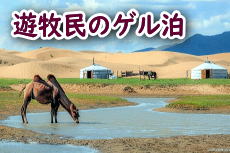
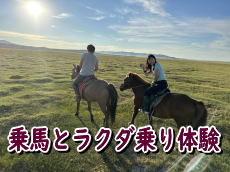
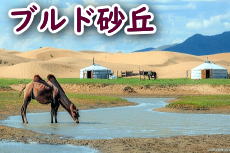
Hotel pickup early at 8 am. On the way, we stop to enjoy a snack and coffee or tea while looking at beautiful scenery.Semi-Gobi DesertAfter arriving at (the Burd dunes), visit the ger of a local nomad and be introduced to nomad culture. Enjoy sightseeing the dunes on a camel for 1 hour. Then a lunch of traditional Mongolian food is served. In the afternoon, horse riding experience on the steppe. Safe even for beginners (1–2 hours). Accommodation is as the traveler wishes. If you wish, you can enjoy the sunset or sunrise from the Burd dunes. At night, a sky full of stars! |
||
|
Day 2 |
Breakfast at the ger camp at 9 am. Relax until departure. At 10 am head toward Ulaanbaatar. On the way,Hustai National Reservesightseeing. We go to see the "takhi," said to be the world's last wild horses. |
|||
|
Meals |
Breakfast: ○ |
Lunch: yes. Dinner: yes |
Dinner: ○ |
|
|
Course code: MO-1028 |
1 person $555 |
2 people $470 |
3 people $405 |
|
|
* The above prices are for a nomad ger stay; for a tourist camp stay add $65. * Based on this itinerary, it is also possible to changefor an extra charge to adeluxe gerwith toilet and shower.. |
||||
MO-1017 World Heritage Karakorum sightseeing, Burd on the steppe, 2 days with 1 night in a ger
▶ Book this tour
|
Old Capital Karakorum Sightseeing and Camel Trekking on the Burd Steppe, 2 Days / 1 Night Course With guide |
||||
   |
Day 1 |
Depart your hotel in Ulaanbaatar at 8:00 am in the morning. By car toold capital Karakorum. On the way, enjoy ice cream at the Harumafuji Milk Farm. The road runs across a vast steppe as far as the eye can see. A steppe drive enjoying nature. Visit a nomad ger and enjoy meeting local people. After lunch, move to Karakorum city. After arrival, free time. Enjoy the natural celestial show (it may not be visible depending on the weather). "Stay at a ger camp" |
||
|
Day 2 |
Breakfast at the ger camp at 8 am. Relax until departure. Move to the Karakorum ruins, the old capital of the Mongol Empire built by the second emperor, Ogedei Khan. On the site of the capital that once became the center of the world, there still standsErdene Zuu Monasterysurrounded by 108 stupas. See also the granite Turtle Rock. After visiting the Karakorum Museum, return to Ulaanbaatar by private car. Camel riding experience on the way. After arriving in Ulaanbaatar, to your hotel. The tour ends. |
|||
|
Meals |
Breakfast: ○ |
Lunch: yes. Dinner: yes |
Dinner: ○ |
|
|
Course code: MO-1017 |
1 person $590 |
2 people $505 |
3 people $405 |
|
|
*The above itinerary and times may change locally depending on weather and traffic congestion on the day. In that case, please follow the instructions of the local staff. We appreciate your understanding. |
||||
▶ Book this tour
|
Old Capital Karakorum Sightseeing and Horse Trekking in Burd National Park3 Days / 2 Nights Course, with guide |
||||
 |
Day 1 |
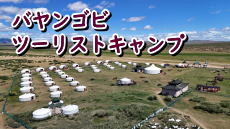
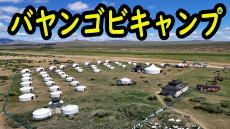
Depart a main hotel in Ulaanbaatar at 8:00 am in the morning. By car to the steppe,Burd, the gateway to the old capital Karakorum. On the way, enjoy ice cream at the Harumafuji Milk Farm. About 4 hours. Lunch time on the steppe on the way. The road runs across a vast steppe as far as the eye can see. A steppe drive enjoying nature. The tourist camp is a "ger tourist camp" with dunes spreading right before your eyes, called Elsen Tasarkhai (a detached stretch of sand), in splendid contrast to the steppe. After arrival, visit a nomad ger and enjoy meeting local people. After dinner, enjoy the natural celestial show (it may not be visible depending on the weather). |
||
   |
Day 2 |
Breakfast at the ger camp at 8 am. Relax until departure. Hiking to the dunes is also possible. Move to theold capital Karakorum ruinsof the Mongol Empire built by the second emperor, Ogedei Khan, about 1 hour. On the site of the capital that once became the center of the world, there still stands Erdene Zuu Monastery surrounded by 108 stupas. See also the granite Turtle Rock. Then return to Burd on the steppe by private car. In the afternoon, receive a riding lesson (explanation) from a nomad (instructor) along with the horses. Then horse trekking starts from the tourist camp as a base. The guide and nomads accompany you. Then camel riding experience at the Burd dunes. "Stay at a ger camp" |
||
|
Day 3 |
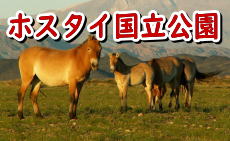
After breakfast, head to Ulaanbaatar at 9 am. On the way,Hustai NationalReserve sightseeing. We go to see the "takhi," said to be the world's last wild horses. |
|||
|
Meals |
Breakfast: yes. Lunch: yes |
Lunch: yes. Dinner: yes |
Dinner: yes |
|
|
Course code: MO-1015 |
1 person $805 |
2 people $640 |
3 people $535 |
|
|
* As options, shooting at targets with a gun, ATV (buggy) andMotorbikerental (250cc) are available. Extra charges apply. |
||||
MO-1024: Nomad Homestay in the Vast Burd of Mongolia, 3 Days / 2 Nights in a Ger
▶ Book this tour
|
Nomad Homestay on the Mongolian Steppe, Unlimited Horse Riding, Open to Beginner Riders! |
||||
  |
Day 1 |
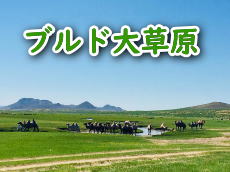
In the morning at 9:00, the English-speaking guide meets you at your local hotel. Move to the ger of a nomad living on the steppe,Burd. On the way, enjoy ice cream at the Harumafuji Milk Farm. Enjoy the car journey, about 4 hours. |
||
   |
Day 2 |
After breakfast, to the old capital of the Mongol Empire built by the second emperor, Ogedei Khan,Karakorum Ruinsabout 1 hour. On the site of the capital that once became the center of the world, there still stands, surrounded by 108 stupas,Erdene Zuu Monastery. See also the granite Turtle Rock. Then return by private car to the nomad ger on the Burd steppe. |
||
|
Day 3 |
After breakfast, head to Ulaanbaatar at 9 am. On the way,Hustai National Reservesightseeing. We go to see the "takhi," said to be the world's last wild horses. |
|||
|
Meals |
Breakfast: yes. Lunch: yes |
Lunch: yes. Dinner: yes |
Dinner: yes |
|
|
Course code: MO-1024 |
1 person $740 |
2 people $605 |
3 people $535 |
|
|
* Shooting at targets with a gun is available as an option. An extra charge applies. |
||||
▶ Book this tour
|
Stay at Tsenkher: Natural Hot Springs and Horse Trekking, 3 Days / 2 Nights Course |
||||
 |
Day 1 |
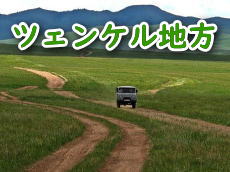
At 7 am, by private car to the steppe,Tsenkher Hot Springs, about 5–6 hours. Enjoy ice cream at the Harumafuji Milk Farm. On the way, move to the old capital of the Mongol Empire built by the second emperor, Ogedei Khan,old capital Karakorum ruins. On the site of the capital that once became the center of the world, there still stands, surrounded by 108 stupas,Erdene Zuu Monastery. See also the granite Turtle Rock. After visiting the Karakorum Museum, head to Tsenkher by private car. After arrival, free time. Enjoy the hot springs that well up on the steppe. |
||
|
|
Day 2 |
After breakfast, horse trekking on the steppe with the nomads from the camp as a base. On the way, visit a nomad's ger. Enjoy the nomads' handmade cheese and, depending on the season, airag (fermented mare's milk). |
||
|
Day 3 |
After breakfast, head to Ulaanbaatar at 9 am, about 5–6 hours. Camel riding experience on the way. After arriving at a main hotel in Ulaanbaatar, thank you for your hard work. |
|||
|
Meals |
Breakfast: yes. Lunch: yes |
Lunch: yes. Dinner: yes |
Dinner: yes |
|
|
Course code: MO-1026 |
1 person $870 |
2 people $670 |
3 people $605 |
|
|
*The above itinerary and times may change locally depending on weather and traffic congestion on the day. In that case, please follow the instructions of the local staff. We appreciate your understanding. |
||||
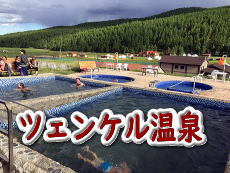
Karakorum Ruins Tour and Burd Grand Steppe Tour
* Prices, times, number of services and opening hours shown are guidelines. They may change, so please ask us for the latest information.
Detailed Guide to Kharkhorin (Karakorum)
| Location | Northwest Uvurkhangai Province, on the bank of the Orkhon River |
|---|---|
| A deluxe hotel staying in Terelj National Park, | About 350 km southwest on a paved road, 5 to 6 hours by car |
| World Heritage | Inscribed as the "Cultural Landscape of the Orkhon Valley" (2004) |
A canal runs through the middle of the village and flows into the Orkhon River. The capital of the Mongol Empire was once located here and was called Karakorum. The second Khan, Ogedei, developed the main transport network and built an international city here. The valley on both banks of the Orkhon River is inscribed as a World Cultural Heritage site, the "Cultural Landscape of the Orkhon Valley". We hope you will stay in Kharkhorin and visit the nearby ruins too.
Getting Around Kharkhorin
Besides public facilities such as the town office and police, there are hotels, guesthouses and restaurants. There are also many tourist camps on the Orkhon riverbed and elsewhere. Just west of the bus terminal is a zakh (market) where food and other goods can be bought.
Start sightseeing with Erdene Zuu. Enter the grounds by the west gate, and after your visit leave by the east gate and go about 5 minutes on foot to the turtle stone and the temple site of Mongke Khan. You can get around on foot, including the Karakorum Museum. Nearby lodgings will usually provide a free transfer from the bus terminal if you contact them in advance. Another option is to take a long-distance bus from Ulaanbaatar to Kharkhorin and join a tour arranged at a guesthouse or similar.
| Bus | From Ulaanbaatar, one departure daily from the long-distance bus terminal, about 6 hours. Fares are subject to change. |
|---|
Highlights
Erdene Zuu (Эрдэнэ зуу)
[A Buddhist monastery that recalls the Mongol Empire era] Founded in 1586, the first Buddhist monastery of the Khalkh Mongols. "Erdene" is the Old Indian "ratna" altered, meaning "treasure". "Zuu" means Buddha image or temple in Tibetan. It was built on the site of Karakorum, the capital of the Mongol Empire, by the Khalkh ruler Abtai Sain Khan. Palace scrap materials were used. At its founding it belonged to the Sakya school of Tibetan Buddhism, but in the time of the living Buddha Zanabazar it converted to the Gelug school.
It is surrounded on all four sides (420 m around) by 102 stupas, which together with six inside the grounds make 108, the sacred number of Buddhism. In the late 18th century 62 halls had been built within the grounds, but in 1939, by order of the head of the people's government, most were destroyed. What remained were only a few, such as the three halls of the three Chinese-style temples (Gurvan Zuu) and the Tibetan-style hall Labrang. It became a museum in 1947 and barely kept alive, and in 1990, after democratization, was revived as a religious facility. In the Gurvan Zuu, besides seated Buddhas of youth, maturity and old age, many fine works of Mongolian Buddhist art remain. In 2004 it was inscribed as UNESCO World Cultural Heritage as part of the cultural landscape of the Orkhon Valley. On a hill outside the grounds a turtle stone from the Mongol Empire era remains, and from that hill you can take in the whole of the monastery.
Turtle Stone (Мэлхий хад)
[A turtle-shaped stone pedestal] A stone statue in the shape of a turtle, often seen in Mongolia, called a turtle pedestal. It was brought from China and made as a base for erecting stone steles. They were made in the Turkic and Uighur eras before the Mongol Empire. There are three turtle stones in the city of Kharkhorin. The first is just northeast of the wall of Erdene Zuu. It is on the site of a Buddhist temple of the Mongol Empire era, Xingyuan Pavilion (the temple site of Mongke Khan), and was protected and restored with German assistance. The second turtle stone is about 500 m east of Erdene Zuu. It was buried underground but is now enshrined above ground. The third turtle stone is placed on a hill about 1 km southwest of Erdene Zuu. A phallic stone is also enshrined beside it. The fourth turtle stone is left unfinished about 10 km west on the outskirts of Kharkhorin.
Karakorum Museum (Хархорум музей)
[Exhibiting buried cultural properties of the Karakorum city ruins] Next to Erdene Zuu, it opened in 2011. It exhibits the results of free aid from the Japanese government and joint research by Japanese and Mongolian researchers. The permanent exhibition is in four parts, the Stone Age, the Bronze Age, the ancient city era and the Mongol Empire era, so you can understand in order the history up to the founding of the Mongol Empire. A must-see is the diorama recreating the capital Karakorum. From the way religious facilities such as Buddhist, Islamic and Christian ones, a Chinese merchants' quarter and a Muslim merchants' quarter are scattered about, you can see that it flourished as an international city, accepting different cultures and guaranteeing freedom of faith and of ways of life. Japanese explanations are also available and easy to understand.
Karakorum, the Former International City
In 1220, on Chinggis's orders, a base for the western expedition was built on the banks of the Orkhon River. After that, Ogedei, the second Mongol ruler, who destroyed the Jin dynasty, began construction of a new city on this site in 1235. In a corner of the steppe where nomadic states such as the Turks and Uighurs had once had their bases, Karakorum, the capital of a world empire, began its journey.
Ogedei placed several detached palaces around it and developed the relay-station system called "yam" to connect the main transport routes to Karakorum. As a result, people, goods, money and information flowed in from all over the world, and Karakorum quickly grew into an international city. According to the French missionary Rubruck, who visited in 1254, around a solemn palace with a nave and aisles there were a Muslim commercial quarter and a Chinese artisans' quarter, and there were said to be 12 Buddhist temples, 2 Muslim places of worship and 1 Christian church. The prosperity of the imperial capital was also widely advertised by figures such as Carpini of Italy and Marco Polo.
Today the site is called Kharkhorin, and the Tibetan Buddhist monastery of Erdene Zuu, built at the end of the 16th century, draws almost all the tourists. There are no ruins to see that convey the splendor of the empire. At the very least, climb the turtle stone hill to the south and look out over Erdene Zuu, and let your thoughts drift to those days. For in the grassland just north of the monastery lies the sleeping city wall, 1,450 m north-south by 1,138 m east-west.
Sights along the Orkhon River
Elsen Tasarkhai (Элсэн тасархай)
Sand dunes continuing about 80 km from the east to the northwest of Batkhaan Mountain, the southern part called Mongol Els (sand) and the northern part Khugnus Tarnyn Els. Near Ulaanbaatar, many travelers visit as a place to casually experience the desert. It is also well located for access to the tourist destination Kharkhorin.
| How to get there | From Ulaanbaatar, a little under 350 km southwest on a paved road. About 4 hours by chartered car. |
|---|---|
| Accommodation | Tourist camps right beside the dunes and more (Mongol Altai Tourist Camp: about 100 beds in gers, English spoken, about US$62 per person, shared toilet and shower, breakfast included) |
Lake Ugii (Өгий нуур)
A freshwater lake in Ugii Nuur district, Arkhangai Province. About half of the lake is shallow, under 3 m deep. It was registered under the Ramsar Convention in 1998 as a habitat visited by about 150 kinds of waterfowl. It is an object of worship for neighboring residents, and women are forbidden to enter the lake water.
Shankh Monastery (Шанхын хийд)
A Buddhist monastery that appears suddenly in the middle of the steppe. In 1647 the living Buddha Zanabazar founded it, wishing for the peace of all living beings. It is located about 25 km southeast of Karakorum. For a long time it moved about as a ger-style monastery, but in 1787 it settled at its present site. Just before the People's Revolution it had 20 temples, but it was closed in 1937 and mostly destroyed. At that time Buddhist heritage such as its Vajrapani statue was moved secretly and escaped loss. Among these, the Kalachakra mandala depicting 722 deities is regarded as the finest piece in Mongolia.
Khoshoo Tsaidam Museum (Хөшөө цайдам музей)
A museum where you can see precious inscriptions up close. It is about 45 km north of Kharkhorin by a direct road. It is attached to a site from the Second Turkic Khaganate, which revived in the latter half of the 7th century and fell in the mid-8th century. Exhibited are the memorial steles of the third ruler Bilge Khagan and his brother Kul Tegin, turtle pedestals, stone statues that adorned the site, rows of stones and other relics. It was developed at the beginning of this century by a joint survey by Mongolia and Turkey, and there are also panels introducing the history of the excavations. The highlight is the two restored and rebuilt Turkic inscriptions (also called the Orkhon inscriptions). They are carved in Old Turkic script and the Old Turkic language. They are historical sources conveying the living voice of the steppe nomads and first-class material for reconstructing Turkic history.
Bilge Khagan Site (Билгэ хааны гэрэлт хөшөө)
A site where a replica of the memorial stele stands as if keeping watch. The mausoleum of Bilge Khagan, who died in 734, is within the grounds of the Khoshoo Tsaidam Museum, as is the site of his brother Kul Tegin, who died earlier in 731. In joint excavations by Mongolia and Turkey that began in 2001, many relics, beginning with gold and silver ornaments, were unearthed from the site of the elder brother's mausoleum. The main finds are displayed in the Chinggis Khaan Museum in Ulaanbaatar (some in the National Museum of Mongolia). Here you can see a full-size replica of the memorial stele, the mausoleum's foundation stones, a huge rock presumed to be a sacrificial altar for offering gifts, and more. At the Kul Tegin site, a memorial stele over 3 m high set on a turtle pedestal has been restored, evoking its former grandeur.
Khar Balgas Site (Хар балгас)
A former walled city that suddenly appears in the steppe. A fortress ruin on the west bank across the Orkhon River from Khoshoo Tsaidam. It was originally the fortress of a protectorate built during Tang rule in the mid-7th century. After the Uighurs defeated the Turks in the mid-8th century and became masters of the Mongolian steppe, it was reused as the Uighur capital. In various sources it is recorded as Ordu Baliq, "city of the throne/palace", and the ruins are also called Kara Balgasun. The central fortress is 420 m × 340 m. Built with the Chinese rammed-earth technique, earthen walls reaching 8 to 10 m survive. Inside the city you can also see partitions of residential areas and earthworks thought to be traces of towers. Climbing the city wall and looking out beyond it, you can get a bird's-eye view of several small towers attached on the south side and, to the southwest, traces of city blocks spreading over a dozen or so km². From this site the Kara Balgasun inscription, carved in three scripts, Sogdian, Chinese and Turkic, was also unearthed.
| Location | Khotont village, Arkhangai Province |
|---|---|
| Open | 24 hours, free |
Khar Bukhyn Balgas Site (Хар бухын балгас)
The traces of a "black ox" left on the steppe. In Mongolian it means "ruins of the black ox", and it is also called the Khar Bukh (black ox) ruins. The square city site of 500 m × 500 m is presumed to have been built in the era of the Khitan (Liao), who ruled the Mongolian plateau in the 9th to 10th centuries. Around it the fortress site Chintolgoi also survives, so you can tour the Khitan-Liao era ruins together. The stone stupa that survives almost in the center of the main wall was added in the first half of the 17th century, in the era when Tibetan Buddhism spread. In 1970, from inside this half-collapsed stupa, a manuscript on birch bark written in Mongolian and Tibetan, the "birch bark documents", was found.
| Location | About 12 km northwest of the center of Dashinchilen district, Bulgan Province |
|---|---|
| Open | 24 hours, free |
Baibalyk Site (Байбалык)
Earthen walls telling stories across the ages. A fortress site built on the north bank of the Selenge River. The second Uighur khagan, Bayanchur (Moyanchur's successor), campaigned in China as reinforcement for the Tang during the famous An Lushan Rebellion (755–763). It is recorded in his memorial inscription, the "Sine Usu inscription", that the city was built with the huge spoils obtained then and rewards from the Tang emperor. Its name is Baibalyk, and it is also known by the Chinese translation "City of Wealth and Honor". On the land now passed down in Mongolian as Bibolak there are three sites. They are square fortresses about 230 m (Bibolak), 140 m (Bor Tolgoi) and 320 m (Arslan Uud) on a side, built with the rammed-earth technique. Many parts have collapsed into mounds, but the remaining part of the east and north walls of the first fortress is about 7 m high.
| Location | Khotag-Undur village, Bulgan Province |
|---|---|
| Open | 24 hours, free |
Orkhon Waterfall (Орхоны хүрхрээ)
Mongolia's largest waterfall. A drop of about 22 m and a width of 5 to 10 m. In Mongolia's low-rainfall climate the water volume cannot always be rich, but it is a popular sightseeing spot as a precious landscape. From the cliff on the south bank you can go down to the plunge pool, but be careful as it is slippery. Nearby there are tourist camps such as the Mungun Khuree Tourist Camp (open only April to November). In winter the water freezes.
Ongi River Site (Онгийн голын дурсгал)
The number of balbal is proof of strength. A Turkic site built in the first half of the 8th century. Lines of stones called balbal are arranged. It is said they were set in as many numbers as the enemies the dead person had defeated in life. Fragments of Turkic inscriptions erected in memory of members of the royal family of the Second Khaganate also partly survive. The main fragments of the inscription are on display in the provincial museum in Arvaikheer. At the site, stone figures (popularly "stone men", khun chuluu in Mongolian) and stone sheep are also placed. Among the balbal, which number over 150 and extend 900 m, there is one standing stone hiding an inscription in Turkic script. Please do observe closely.
Tövkhön Monastery (Төвхөн хийд)
A monastery in the sky floating over the Khangai. In 1648, the living Buddha Zanabazar liked this place and founded this Buddhist monastery. Its halls stand on the summit of Shireet Ulaan Mountain, straddling the north and south Khangai. In 1688 it was caught up in the conflict between the Oirats of western Mongolia and the Khalkh and fell into ruin, but it was revived in 1773. In 1939 the people's government destroyed it, leaving two temples and two stupas, but it was rebuilt after democratization. Because it is a mountain monastery, you have to go back and forth by a rocky route, and climbing equipment and mental preparation are needed, but the scenery is beautiful.
[Golden Week only, 5 days / 4 nights] <fuel surcharge included> [MIAT Mongolian Airlines] First-Time Mongolia, 5 days A Golden Week tour that will fully satisfy you in Mongolia: the Burd steppe, Karakorum ruins, starry sky, ger stay, Hustai National Park wildlife viewing, city sightseeing and a Mongolian folk concert.

Aim for World Heritage Karakorum! Horse Trekking and Tent Stay, 8 Days
A summer horse trekking course recommended for repeat visitors. You travel across the steppe with your horses and tents. A private vehicle, a cook, a horse handler and an English-speaking guide are arranged, so it is a course you can join with peace of mind.
Central Mongolia Tour: Orkhon Valley, Natural Hot Springs and Ugii Lake, 8 Days
An adventure tour racing across Mongolia's great nature by jeep. See World Heritage Karakorum, Ugii Lake, Taikhar Rock, Terkhiin Tsagaan Lake, the Undurshiret steppe, Hustai National Park and more.
Naadam Festival, Karakorum Ruins and Tsenkher Hot Springs, 8-Day Tour
3 nights in a city hotel and 4 nights in a ger, watching a Naadam festival event on the steppe. You can also see Erdene Zuu Monastery surrounded by white walls, Turtle Rock, the Karakorum Museum, Tsenkher hot springs, and ride horses on the steppe.
Karakorum Ruins, Khorgo Volcano and Lake Khuvsgul, 8-Day Tour
After visiting the Karakorum ruins and the Khorgo volcano, go to Lake Khovsgol, called the "Switzerland of Mongolia," Mongolia's largest freshwater lake near the Russian border. On the lakeshore live the Tsaatan people, who keep reindeer.
Mongolian Gobi Desert, Khongor Sand Dunes and Orkhon Valley Tour, 10 Days
Baga Gazriin Chuluu, Yolyn Am valley, Khongor Sand Dunes, Ongi Monastery, Karakorum ruins and the Burd steppe. The best tour around Mongolia. 2 nights in a city hotel, 1 night in a nomad homestay, 6 nights in a ger camp.
Horse Riding, Karakorum Ruins, Mongolian Ger Stay and Nomad Experience, 5 Days
World Heritage Karakorum ruins, the steppe and the beautiful dunes of Burd, a nomad homestay, a horse riding experience and a camel riding experience. The best course for getting to know Mongolia.
2 Nights in Ulaanbaatar, 2 Nights in Burd, Karakorum Ruins and Horse Riding, 5 Days
World Heritage Karakorum ruins, the steppe and the beautiful dunes of Burd, a horse riding experience and a camel riding experience in Burd. A local guide shows you around. The best course for getting to know Mongolia.
World Heritage Karakorum Ruins, 1 Night in Orkhon Valley, 1 Night in Burd, 5 Days
World Heritage Karakorum ruins, the steppe and the beautiful dunes of Burd, a horse riding experience and a camel riding experience in Burd. A 5-day tour with horse and camel riding, seeing Karakorum and the Orkhon Valley.
Eastern Gobi Sainshand, Karakorum Heritage and Tsenkher Hot Springs, 8 Days
East Gobi by train, a fossil digging experience and the meditation places of ancient lamas, Karakorum heritage and Erdene Zuu Monastery. Free plan at Tsenkher hot springs. A ger stay and horse riding experience are also included.
Karakorum Ruins, Tsenkher Hot Springs and Undurshireet, 8 Days
Mongolia's top course. 1 night in a nomad ger on the Undurshiret steppe, World Heritage Karakorum sightseeing and a soak in the natural Tsenkher hot springs. The hot springs are deeply satisfying. 2 nights of horse trekking in beautiful Burd, and Hustai National Park, an 8-day course
Central Province: Assemble a Portable Ger and Go Horse Trekking, 8-Day Course
You can join even alone. Enjoy horse trekking on the Mongolian steppe and work together to assemble a ger. An English-speaking guide and a skilled cook accompany you. You ride 20–30 km a day. Beginners can join too.
Hot Springs on the Mongolian Steppe! World Heritage Karakorum and Hustai National Park
World Heritage Karakorum and a hot spring trip at the same time! Ride across the steppe and see the World Heritage Karakorum ruins and Erdene Zuu Monastery. A ger camp stay at Tsenkher hot springs, a horse riding experience, and the wild takhi horses at Hustai.
Khongor Sand Dunes, Horse and Camel Riding, World Heritage Karakorum, 8 Days
Using domestic flights and staying in a ger, enjoy camel and horse riding to your heart's content while looking at the beautiful nature of the South Gobi. See World Heritage Karakorum, Erdene Zuu Monastery and the Burd steppe.
Mongolian Gobi Desert, Central Gobi and Safari Tour by 4WD, 8 Days
A 4WD safari tour seeing the Yolyn Am valley, Khongor Sand Dunes, Bayanzag, Ongi Monastery, Karakorum ruins and the Burd steppe.
Ugii Lake, Tsenkher Hot Springs, Orkhon Valley and Gobi Desert, 10-Day Tour
After seeing Ugii Lake, Tsenkher hot springs, Karakorum ruins, Ongi Monastery, Bayanzag, Khongor Sand Dunes and the Yolyn Am valley, return to Ulaanbaatar by plane. 2 nights in a city hotel, 8 nights in a ger camp
Mongolian Gobi Desert, Orkhon Valley, Tsenkher Hot Springs and Ugii Lake, 11 Days
A tour going around Baga Gazriin Chuluu, Yolyn Am valley, Khongor Sand Dunes, Bayanzag, Ongi Monastery, Karakorum ruins, Tsenkher hot springs and Ugii Lake. 2 nights in a city hotel, 8 nights in a ger camp
Golden Eagle Festival and World Heritage Karakorum, 9 Days
Departing 9/28: Karakorum Ruins and the Golden Eagle Festival Tour in Mongolia's Westernmost Province. The Kazakhs living in Bayan-Ulgii Province are famous for hunting with golden eagles.
Bird Watching and Wild Bird Photography Tour on the Mongolian Steppe, 8 Days
Travel from the taiga to the steppe and enjoy bird watching that differs by environment, guided by Mongolian experts with broad knowledge of the birds of Mongolia.
Bird Watching and Wild Bird Photography Tour on the Mongolian Steppe, 11 Days
Mongolia can be called one of the meccas of bird watching in East Asia. In cooperation with the Mongolian Ornithological Society (NGO), we arrange a specialist bird guide. An English-speaking guide accompanies you throughout.
Head for the Eight Lakes, Horse Trekking and Bubble Tent Tour, 8 Days
Ride across the steppe with the wind. Travel on horseback to the eight lakes where Mongolia's best starry sky can be seen. See Naiman Nuur and the Karakorum ruins. An 8-day tour with tent stays. One private vehicle and a cook travel with you, so you can feel secure.
8-Day Tour Riding Off-Road Motorbikes across the Mongolian Steppe
We use high-class bikes such as the KTM and the Yamaha Serow 250. A tour enjoying bikes with a hot air balloon on the Undurshiret steppe, the Karakorum ruins, Terkhiin Tsagaan Lake, Ugii Lake and the Burd dunes.



Basic Mongolia Information
Basic information

Tourist Destinations in Mongolia
Destination
Travel Guide
Travel guide
Winter Tours
Winter tours
Tailor-Made Travel
Tailor-made
Tourist Events
Tour events
Tourist Camps
Tourist camps
Ulaanbaatar Sightseeing
UlaanbaatarCity Tour

Mongolian Food
Mongolian Foods
Restaurant Guide
Restaurants
Gallery
Gallery
Car Rental
Car Rental
FAQ
FAQ